AWS landing zone
I failed to redact my own account ID four times while trying not to. So I stopped trying.
In one Sunday session I leaked identifiers from my own AWS estate four times. I was not careless. I was actively, deliberately trying not to. Every time, the value I was looking at was redacted perfectly, and the one sitting next to it went straight through.
That was the day I stopped treating redaction as a rule I follow and started treating it as a control I test.
Why an account ID is worth hiding at all
The repository for my AWS landing zone is public. It is a four account AWS Organization, built so that every guardrail has a test that tries to break it. Being public is the point: a hiring manager should be able to read every decision.
An AWS account ID is not a secret in the way a password is. AWS says as much. But an account ID published next to what that account is for, which region it runs in and the names of its roles stops being trivia. It becomes a targeting primitive. Cross-account trust can be probed from outside, without touching the account and without appearing in its CloudTrail.
So the rule was simple. Account IDs, the organisation ID, OU IDs, root email addresses, access key IDs and the Identity Center portal URL never appear in the repository, a screenshot, a diagram or a post.
Simple rules are the ones you get wrong while feeling confident.
The shape of every miss
Every failure had the same shape, and that is the useful part.
I ran aws sts get-caller-identity, carefully replaced the Account value
with a placeholder, and pasted the rest. The UserId line above it carried the
role’s unique ID, the one that starts with AROA. I never looked at it. I was
looking at the account.
I pasted a terraform plan with the target account blanked out. Two lines
higher, in the refresh output I had scrolled past a hundred times, sat the
organisation ID and the root ID.
Over-redaction is the same failure pointed the other way. I blacked out a screenshot so thoroughly that it no longer showed which account it was about. A proof that proves nothing is worse than no proof, because it still looks like evidence. I also redacted commit SHAs, which identify nothing and are useful to a reader.
It even happened while I was writing the decision record about it. Twice in ten minutes, a plan to answer a question with “yes” or “no” lost to the habit of pasting the whole output.
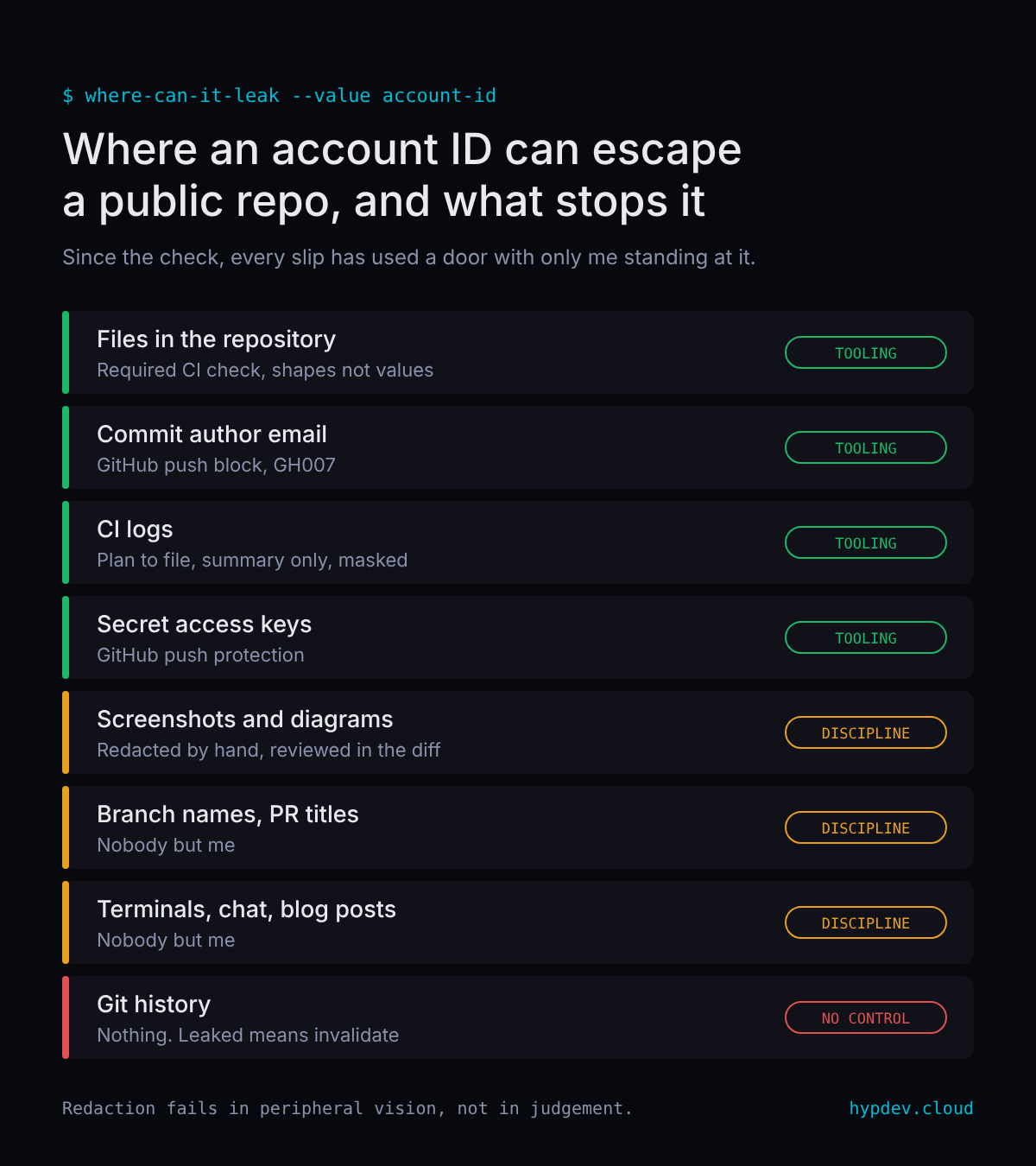
Redaction fails in peripheral vision, not in judgement. A rule that depends on noticing every value fails on the value nobody was looking at. More attention does not fix that. Attention is the thing that is running out.
Moving the rule out of my head
The decision, recorded as ADR 0003, was blunt: redaction is enforced by tooling at every point where a value can become public, and a human check is never the only control.
For files, that is a required status check. A short script runs on every pull
request and on every push to main. It matches the shape of each
identifier, never its value. An excerpt from scripts/check-redaction.sh:
check "AWS account ID"         '\b[0-9]{12}\b'
check "AWS organisation ID"    '\bo-[a-z0-9]{10,32}\b'
check "Organizational unit ID" '\bou-[a-z0-9]{4,32}-[a-z0-9]{8,32}\b'
check "AWS key or unique ID"   '\b(AKIA|ASIA|AROA|AIDA)[A-Z0-9]{16}\b'
Three choices in it are deliberate, and each one closed an argument I had with myself.
Shapes, not values. Matching my real account IDs would have no false positives. It would also mean committing a list of my real account IDs to a public script, which publishes exactly what it protects.
It reports the file and line, never the value. A check that prints the leak into a public CI log has moved the leak, not stopped it.
There is no exemption list and no inline suppression. Every exemption is a hole, and a hole is where the real value eventually sits. If a document needs to talk about a twelve-digit number, it describes it instead of printing it.
The other exits got their own controls. GitHub blocks any push whose commits carry my private email address. Terraform output in CI goes to a file, with only the summary printed. Secret access keys are left to GitHub push protection, which verifies candidates against AWS and is both more accurate and earlier than any regular expression I could write.
Before trusting any pattern, I fed it a value it had to catch. A detector you have only ever seen stay quiet is a detector you are assuming works.
Proving it, the same way as every other control
Every control in this project gets attacked before I call it done. This one was no different.
I opened a pull request containing a single synthetic value in the shape of an account ID, generated at the command line so the write-up of the proof never contains it. The check turned red in forty seconds and the log said this, and nothing more:
BLOCKED: AWS account ID
docs/leak-sample.md:1
Error: Process completed with exit code 1.
The merge button was disabled. An ordinary pull request with no blocked values ran the same check, under the same ruleset, and passed in five seconds. That second pull request is the control group: without it, a red check proves only that something is red.
Then I tried to push a commit authored with my private email address. GitHub refused it before any branch existed:
GH007: Your push would publish a private email addressThe placeholder that fails its own check
This was the detail I did not expect.
The example account ID used throughout the AWS documentation is twelve digits long. So a page in my repository that quoted it, perhaps the very page explaining the redaction rules, would fail the check it describes.
A placeholder that can match its own rule is a bug. Mine are angle-bracket
tokens that name what was removed, <account-id:mgmt> or <org-id>, which no
pattern will ever match and no reader will ever mistake for a real value.
The same day taught me a smaller lesson. The script reads git ls-files, so a
brand new file passes locally until it is staged. Stage, then check. A gate
that silently skips the newest file is exactly the gate you trust most and
should trust least.
What the check still cannot see
Tooling covers what it is pointed at. This one reads text files at one commit. It does not read images, git history, branch names, pull request titles, or anything outside the repository.
Today, building the organisation trail and the log archive for this same estate, I slipped four more times. An account ID in a hint line under a form field in a screenshot. An account ID inside an ARN in an error message, twice. And a masking filter I was using on my terminal output covered twelve-digit account IDs but not the organisation ID or the policy ID that came back in an access denied message.
None of them reached the repository. That is the whole argument, measured again: the door with a check on it held, and every slip went through a door without one.
So I no longer ask “did I redact this?”. I ask “which exit is this value about to use, and what is standing at it?”. When the answer is “me”, that exit goes on the list for tooling next.
This post is part of a public build of an AWS landing zone whose guardrails are proven rather than declared. The decision record, the redaction rules and the proof are in the repository: github.com/iamhyp/aws-landing-zone.
Next in the series: the log archive, and the three layers that refused to let me delete my own audit logs.